Moving to Barcelona to start university means discovering a city full of opportunities, but also learning how to get around. Between lectures, group assignments, libraries and meeting up with friends, knowing how to travel around the city can help you manage your time and keep your expenses under control.
Fortunately, Barcelona has an extensive public transport network connecting its main neighbourhoods, universities and many municipalities in the metropolitan area. You can also combine metro and bus journeys with trains, cycling or walking.
If you’re planning to study in Barcelona, this Unihabit guide explains which types of transport you can use, which travel passes might suit you best and what to consider when choosing accommodation with good connections to your university.
Barcelona Metro: one of the most convenient ways to get around
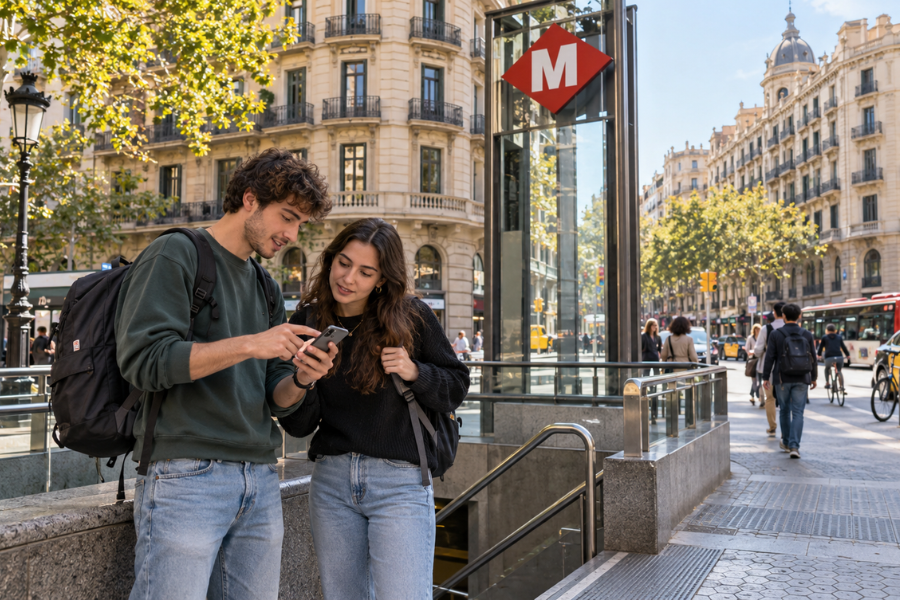
The metro is one of the most popular ways to get around Barcelona. It allows you to travel relatively long distances and reach different parts of the city without worrying about traffic.
The Transports Metropolitans de Barcelona (TMB) metro network has several lines identified by a letter and a number, such as L1, L3 and L5. There are also lines operated by other companies that form part of the metropolitan transport network.
The metro can be particularly useful if you need to travel between your accommodation, university and the areas where you meet your classmates.
You can check routes, timetables and possible service disruptions on the official TMB website.
Bus: another way to reach more places
City buses are another option for getting around Barcelona. They can be particularly convenient when there isn’t a metro station nearby or you want to reach somewhere without making too many transfers.
Before travelling, check your nearest bus stop, the direction of the route and the next arrivals. Keep in mind that traffic can affect journey times, especially during rush hour.
You can combine bus journeys with the metro and other types of transport using integrated travel tickets that are valid for the relevant operators.
To plan your journeys, check the TMB routes and services.
Trains, Trams and FGC: options for getting to your campus
Not all universities are located in central Barcelona. Some are in nearby towns or areas where you may need to combine different types of transport.
That’s why, in addition to the metro and buses, it’s important to know about other options.
- Ferrocarrils de la Generalitat de Catalunya (FGC): connects Barcelona with different towns and university areas across the metropolitan region.
- Rodalies de Catalunya: can be useful if you live outside Barcelona or need to travel from other towns.
- Tram (TRAM): connects different areas of Barcelona and the surrounding metropolitan region.
For example, if you study at a campus outside the city centre, taking the train may be an important part of your daily commute. On the other hand, if you live and study in the same area, you might only need a short metro journey followed by a walk.
Check routes and timetables on the official websites of FGC, Rodalies de Catalunya and TRAM.
Which public transport pass should you choose as a student?
Transport costs are something worth including in your monthly budget. If you attend classes almost every day, buying individual tickets may be less convenient than using a travel pass.
Barcelona and its metropolitan area offer several integrated public transport tickets and passes. The best option depends on your age, how often you travel and the fare zones you need.
Here are some of the options to consider.
| Ticket or pass | What does it offer? |
|---|---|
| T-jove | For young people under 30. It allows unlimited journeys for 90 consecutive days across all zones of the ATM Barcelona integrated fare system. |
| T-usual | Allows unlimited journeys for 30 consecutive days within the selected fare zones. |
| T-casual | Includes 10 journeys and may be suitable if you only use public transport occasionally. |
| T-familiar | Allows 8 journeys to be shared between different people over 30 days, subject to its conditions of use. |
You can find more information about each option on the T-mobilitat website and official fares page.
How Can You Choose the Right Travel Pass?
Start by estimating how often you travel each week:
- If you attend classes five days a week and use several types of transport, compare the T-jove and T-usual.
- If you only travel on certain days, check whether a 10-journey ticket would be better value.
- If you live outside Barcelona, check how many fare zones you need to cover all your journeys.
Don’t choose a travel pass based on price alone. Check its validity period, which types of transport you can use and the conditions of use.
Cycling and Walking: Explore Barcelona at Your Own Pace
Not every journey requires public transport. If your accommodation is close to your university, walking or cycling can be a convenient way to save money on shorter journeys.
Getting Around by Bicycle
Barcelona has cycle lanes and routes that allow you to travel around different parts of the city. Before setting off by bike, plan your route and check which paths are suitable for your journey.
You can also find out about Bicing, Barcelona’s public bicycle-sharing service. Check its eligibility requirements, subscription options and prices to see whether it’s a good option for you.
Remember to follow traffic regulations, use designated cycle routes and secure your bicycle properly when parking it.
Walking Around the City
Walking can be a good option for getting to university, going to the library, shopping near your accommodation or meeting classmates.
As well as reducing the need for some public transport journeys, it allows you to explore the neighbourhoods, discover local shops and get to know your new surroundings.
Unihabit’s university residences are located near different university campuses and educational institutions, making it easier to get around on foot. For example, the Girona residence is close to the Montilivi campus; the Sant Cugat residence is near ETSAV; and the Manresa residence is close to UManresa and UPC. In Barcelona, the residences are near universities and institutions such as UB, Elisava and Universitat Pompeu Fabra.
If you’re still unfamiliar with Barcelona, try to identify the services close to your accommodation, such as supermarkets, pharmacies, libraries, green spaces and public transport stops.
Useful apps for planning your journeys
When you start exploring a new city, having the right apps on your phone can make getting around much easier.
Here are some useful options:
- TMB App: To check metro and bus information, plan journeys and view service alerts.
- Google Maps: To compare routes, check estimated travel times and find stops, stations and addresses.
- T-mobilitat: To find information about integrated public transport tickets and the available ways to manage them.
A good habit is to check your route before leaving, especially if you need to arrive on time for an exam or an important class.
If there are roadworks, disruptions or changes to services, look for up-to-date information through the transport operator’s official channels.
How to choose accommodation based on your university and transport connections
Location is one of the most important factors when choosing where to live during university. Good transport connections can help you make better use of your day, get more rest and spend less time travelling.
At Unihabit, you can explore different student accommodation options across Catalonia.
Barcelona – Ciutat Vella
An option for students who want to live in central Barcelona and consider the transport connections to different universities and services. Explore Unihabit’s accommodation options at the residence in Barcelona.
Barcelona – Gràcia
An alternative for students looking to live in a neighbourhood with shops, squares and public transport connections. Discover Unihabit’s student residence in Gràcia.
Sant Cugat
This may be an option for students whose university or educational institution is located in Sant Cugat, particularly at ETSAV. Check the transport connections to your campus. Explore the student residence in Sant Cugat.
Girona
For students studying in Girona who prefer accommodation in the same city, close to their academic activities. Explore the student residence in Girona.
Manresa
The residences in Manresa are a convenient option for students studying in the city who want to live close to their university in a good location. Find out more about Unihabit’s university residence in Manresa.
You can start by visiting the official Unihabit website and comparing the locations with your university’s exact address.
The best accommodation isn’t necessarily the one that’s closest in a straight line, but the one that fits your budget and allows you to get to class comfortably.
Tips for your first days in Barcelona
During your first few weeks, it’s normal to need to check routes and get familiar with stations. With a little planning, getting around will soon become part of your daily routine.
Before classes begin, try following these tips:
- Test your route to university before your first day.
- Find the stations and stops closest to your accommodation.
- Check which public transport pass is best for you.
- Save your university and accommodation addresses on your phone.
- Check for possible service disruptions if you have an exam or an activity at a fixed time.
- Consider late-night transport connections if you’re planning to return home late.
- If you need to travel to another town, check the fare zones and return timetables.
Knowing which transport options are available will help you settle in more easily and enjoy everything the city has to offer, both inside and outside university.

Frequently asked questions about getting around Barcelona as a student
Can You Pay for Public Transport in Barcelona With a Bank Card?
Payment options depend on the type of transport, the operator and the ticket you use. Before travelling, check the accepted payment methods on the service’s official website and find out whether you need a specific transport card.
What time does the Barcelona metro close?
Opening hours vary depending on the day of the week and may change on special dates. Check the official TMB timetables before planning a late-night journey.
What happens if I lose my transport card?
Whether you can recover or replace a ticket or pass depends on how you purchased it, whether it is personalised and the service’s conditions. Check the official T-mobilitat information to find out which procedure applies to your situation.
Is it safe to take public transport home after a night out?
As in any major city, it’s advisable to take the usual precautions: keep an eye on your belongings, plan your journey home and check transport timetables. If your usual service is no longer running, look into the available alternatives before heading out.